How I Test Web Hosting
Every page on this site uses the same six checks. I don't publish a number that I didn't measure myself or read on the host's own website.
Some links on this site earn me a commission if you buy. It never changes your price. How this works
Six checks, every host
The same order, the same tools and the same questions, so one page can be compared with another.
- 01
Start from my own account and invoices
Where I am a customer, the review starts from my real bills. My GoDaddy pages use ten years of my own invoices, and my Hostinger pages use the plan this website runs on today. Bills show things a pricing page never shows, like an extra charge added at renewal.
I recordPrice paidRenewal billedExtra charges - 02
Check every price on the host’s own site and cart
I take prices only from the host’s official pricing page and cart, never from other blogs. I note the term the low price needs, the renewal price, and the add-ons the cart tries to sell you. Every price on the site carries the month I checked it.
I recordIntro price and termRenewal priceCart add-ons - 03
Test the speed of live websites
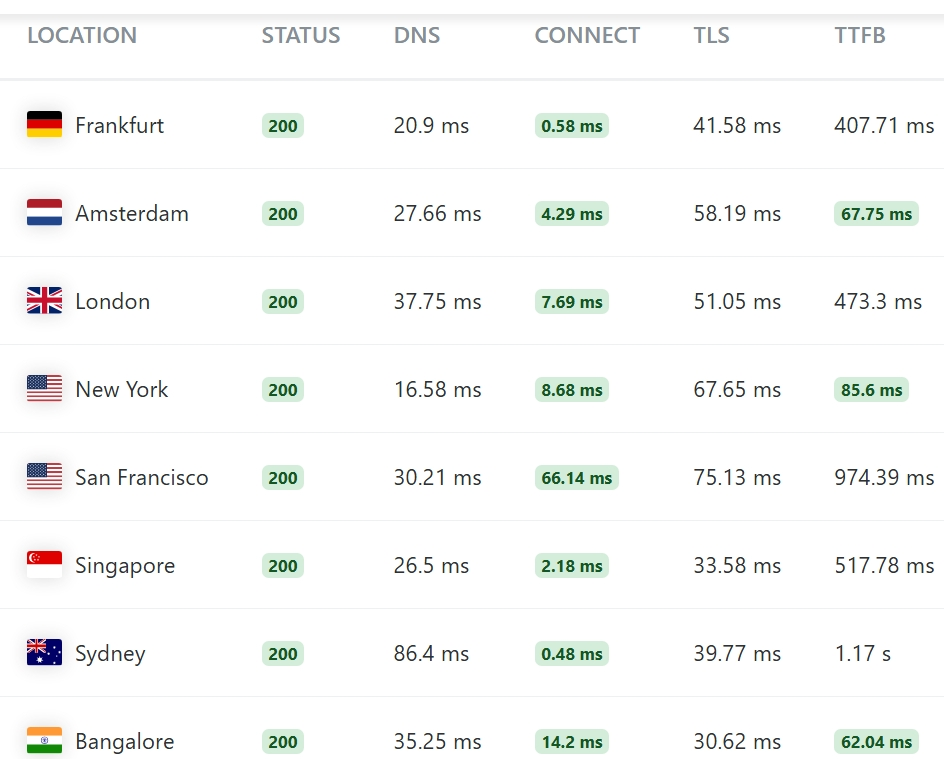
I measure TTFB (time to first byte) on live websites hosted on each host, from 8 cities: Frankfurt, Amsterdam, London, New York, San Francisco, Singapore, Sydney and Bangalore. I test the final https address of each site, so the result is the real page and not a redirect, and I show the median and every site’s numbers.
I recordTTFB per cityServer locationNumber of sites - 04
Ask the sales chat the same questions
Before you buy, the sales chat is the support you meet first. I ask every host the same questions: the renewal price, backups and how many days are kept, free migration, and the CPU and RAM limits. I note how long the reply took, how many questions got a real answer, and if a human or an AI answered.
I recordTime to replyQuestions answeredHuman or AI - 05
Read the status page
Every big host has a public status page where it posts outages. I compare hosts over the same weeks, count the incidents and how long each one lasted, and I also note how much history the host shows. A host that hides its history gets no credit for looking clean.
I recordIncidentsLongest oneHistory shown - Most reviews skip this06
Do the renewal math
One host asks for 48 months, another for 36, so the monthly price alone doesn’t compare fairly. I add the first term and the renewal after it over the same six years, and I include the costs that start in year two, like SSL or email.
I recordFirst term totalRenewal per year6-year total
Every review says where its data comes from
Tested hands-on
I use or used this host myself. The page includes my own account, bills and experience, plus all the other checks.
Researched + live-site tests
Prices from the host’s own site and cart, speed tests on live websites hosted there, my sales chat test and their status page.
Test account
If a host ever gives me a free account for testing, the review says so clearly at the top.
How the score works
No secret formula. The score is the average of the marks shown on the review.
| What I mark out of 10 | Based on |
|---|---|
| Price after the first termMatters most | Renewal price, extra charges and the 6-year total |
| Support | My sales chat test and, where I am a customer, my own support history |
| Speed | TTFB from 8 cities on live websites |
| Ease of use | Control panel, buying process and moving a site in or out |
Example: my GoDaddy review scores 5.5 out of 10, the average of five marks shown on the page. Price after the first term got 3 out of 10.
What I never do
- Sell a rankingNo host can pay to move up a list. There are no paid placements on this site.
- Publish a number I didn’t measureIf a test isn’t finished, the page shows it as pending instead of guessing.
- Hide the renewal priceIf I can’t find it, the page says so in plain words.
- Copy prices from other blogsMany old offers are still repeated online. I check every price on the host’s own site.
A real test log
The Hostinger plan this website runs on, as it appears in my GoDaddy vs Hostinger comparison.
- Bought on
- 6 August 2026
- Paid
- ₹9,552 for 48 months
- Renews at
- ₹31,152 for 48 months
- Data center
- India
- US
- 841 ms
- Europe
- 489 ms
- Singapore
- 535 ms
- Sales chat
- 5 of 6 answered in one reply
- Status page
- Per-server entries, about 2 weeks shown
Full details in my GoDaddy vs Hostinger comparison.
Testing questions
Do you use the hosts you review?
Where I can, yes. This website ran on GoDaddy for close to ten years and runs on Hostinger now, and those pages use my own invoices. Every review is labelled, so you can see if it is tested hands-on or based on research and live-site tests.
Do hosts pay for reviews or rankings?
No. Some hosts pay me a commission when you buy through my links, but no host can pay for a review, a score or a higher place in a list. GoDaddy pays me commission and its score is 5.5 out of 10.
How often do you update prices?
I re-check prices every month, and each price on the site shows the month it was checked. When a host changes a price or an offer ends, I update the page and its date.
Why TTFB and not full page load time?
TTFB shows how fast the server starts answering, which depends on the hosting and the server location. Full load time depends much more on the theme, images and plugins of each site, so it says less about the host.