HG
HostGator
Hatchling shared plan
$3.75/moRenews $10.99
- 10 websites on the cheapest plan
- Free SSL and Cloudflare CDN, every year
- Faster in the US and Europe in my test
GoDaddy vs HostGator in 2026: renewal prices, what the entry plans really include, speed tests on live sites, and which one to pick in the US or India.
Hatchling shared plan
Economy shared plan
GoDaddy vs HostGator is a common question, because both are among the oldest names in web hosting and both are still among the most searched. If you are trying to decide between them, the honest answer in 2026 is that they are good for different people, and the deciding points are not the ones on their homepages.
I hosted my own website on GoDaddy for close to ten years, so for GoDaddy I am using my own invoices, a sales chat test and speed tests on live GoDaddy sites. For HostGator I am using their pricing page, their price chart and terms of service, a sales chat test and speed tests on four live HostGator sites. Below you will find each round, the winner of each round, and who should pick which.
Both hosts show a low monthly price for a 3-year term, and both go back to the regular price after that. So look at two numbers: what you pay for the first three years, and what you pay every year after that. HostGator is lower on both.
| Plan | HGHostGator | GDGoDaddy |
|---|---|---|
| Entry plan | Hatchling, 10 sites | Economy, 1 site |
| Intro price (36 months) | $3.75/mo | $5.99/mo |
| You pay for 3 years | $135.00 | $215.64 |
| Renewal, 36-month term | $10.99/mo | $11.99/mo |
| Years 4 to 6 on renewal | $395.64 | $431.64 |
| Renewal, 12-month term | $13.19/mo ($158.27/yr) | $11.99/mo ($143.88/yr) |
| Middle plan | Baby, 20 sites | Deluxe, 10 sites |
| Middle plan intro (36 months) | $4.50/mo | $7.99/mo |
| Middle plan renewal, 36 months | $16.49/mo | $16.99/mo |
| Top shared plan | Business, 50 sites | Ultimate, 25 sites |
| Top plan intro (36 months) | $6.25/mo | $12.99/mo |
| Top plan renewal, 36 months | $21.99/mo | $21.99/mo |
HostGator prices from their US hosting page and price chart, GoDaddy from its US pricing page. Checked October 2026, before tax.
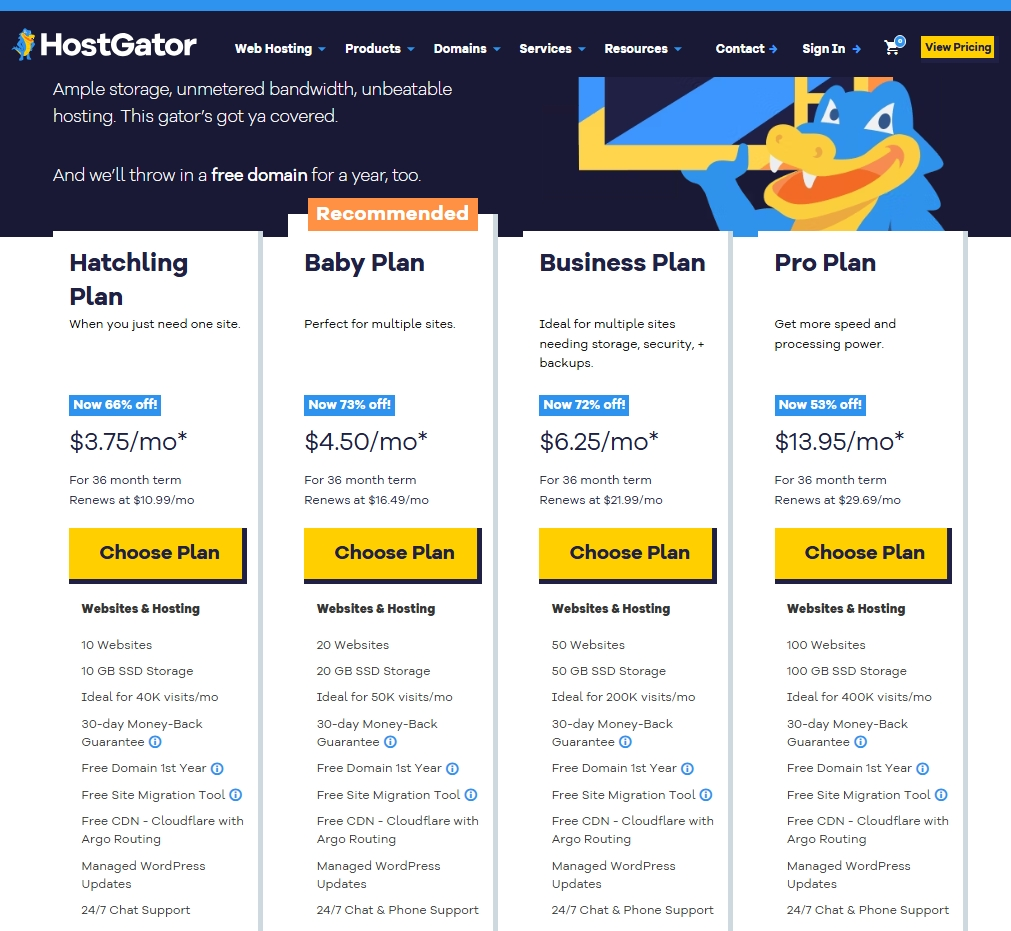
On the entry plan, six years on HostGator Hatchling come to $530.64 and six years on GoDaddy Economy come to $647.28, before tax. That is about $117 more on GoDaddy, and you still have to add the SSL on Economy from year two. On GoDaddy Deluxe and Ultimate, SSL is included for all years. HostGator also has a fourth plan, Pro, for 100 sites at $13.95 a month, renewing at $29.69.
There is one case where GoDaddy is cheaper. If you renew for only one year at a time, GoDaddy Economy renews at $11.99 a month ($143.88 a year), while HostGator Hatchling renews at $13.19 a month ($158.27 a year), because HostGator charges more for a short term. So with HostGator, renew for 36 months to get the lower price.
The bigger difference is what you get for the price. HostGator’s cheapest plan allows 10 websites, while GoDaddy Economy allows only 1. If you have two or three small sites, HostGator Hatchling covers all of them, and on GoDaddy you would need Deluxe.
HostGator includes a free Let’s Encrypt SSL on every plan, every year. GoDaddy Economy includes SSL for the first year only. When I asked GoDaddy’s sales chat from my account, they told me the SSL renewal is ₹5,999 a year, almost as much as the hosting renewal itself.
| Feature | HGHatchling | GDEconomy |
|---|---|---|
| Websites | 10 | 1 |
| Storage | 10 GB SSD | 25 GB NVMe |
| Free domain | Year 1 | Year 1 |
| Free SSL | All years | Year 1 only |
| CDN | Cloudflare CDN included | Not listed on the plan |
| Firewall and malware removal | Included | Paid Web Security add-on |
| Backups | Weekly courtesy backups, daily is paid | Daily, restore previous day |
| Control panel | cPanel | cPanel |
| Support on entry plan | 24/7 chat (phone from Baby up) | Chat and phone |
| Migration | Free self-service tool, paid if their team does it | No answer from sales chat |
| Money-back | 30 days, $17.99 kept for the free domain | 30 days |
From HostGator’s US hosting page, terms of service and sales chat, and GoDaddy’s plan page and India cart, October 2026.
HostGator’s cheapest plan now includes things that are paid add-ons on many hosts: Cloudflare CDN, a web application firewall, malware scanning and removal, a WordPress staging site and SSH access. On GoDaddy, the firewall and malware removal are part of the Web Security add-on that the cart offers you at checkout.
Three things in HostGator’s fine print are worth knowing before you buy. First, their terms say backups are a courtesy and you are responsible for your own backups. If your account is over 20 GB, files are not included in their off-site backup. Second, if you take the money-back guarantee, HostGator keeps $17.99 for the free domain. Third, migration. The sales chat told me WordPress migration is free, and the plan cards say “Free Site Migration Tool”, but the compare table on the same page says “Paid Migration Available”. So the free part is a tool you run yourself. If you want their team to move your site, ask the price before you buy.
Both companies make a lot of money from add-ons, so read the cart carefully on either one. These are the prices from their own pages and chats:
The GoDaddy charge that surprised me most was PHP Extended Support. If your site runs on an old PHP version, GoDaddy adds it automatically at renewal. It was on my own 2025 invoice. I didn’t find a similar charge in HostGator’s add-on price list, but check your PHP version on either host anyway, because old PHP is also a security risk.
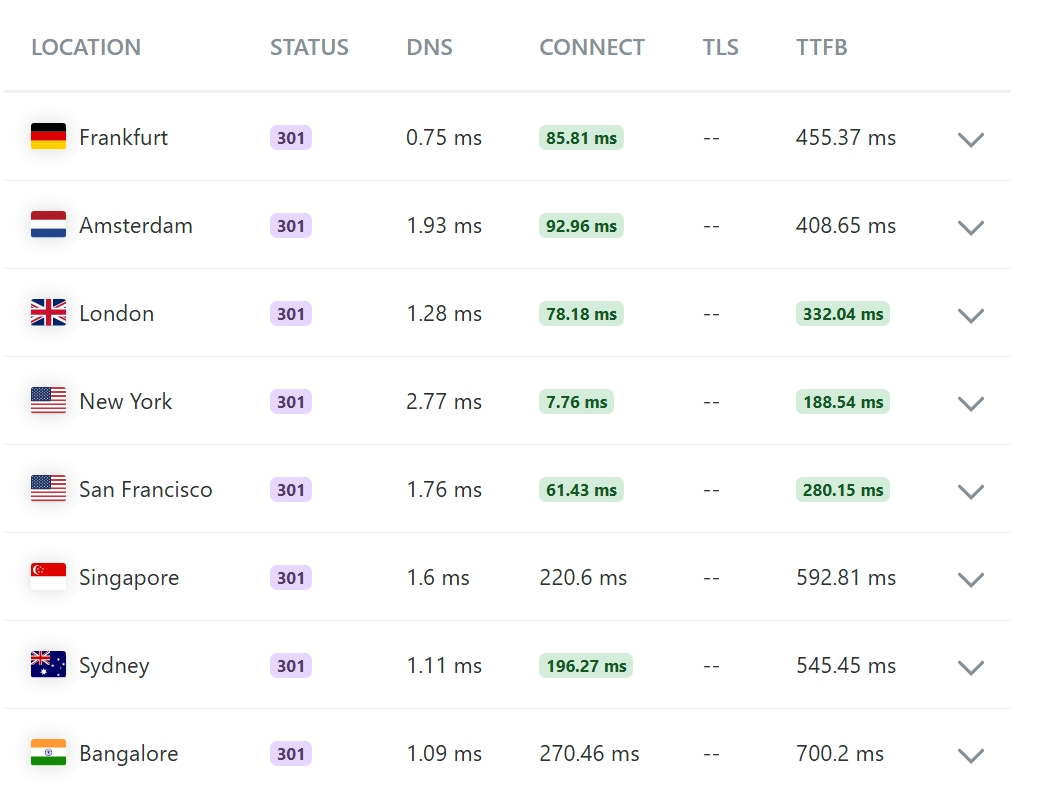
I measured TTFB (time to first byte) on four live websites hosted on each company, from 8 cities with the KeyCDN Performance Test. TTFB shows how fast the server starts answering, which depends mostly on the hosting and on how far the server is from the visitor.
| Median TTFB | HostGator | GoDaddy |
|---|---|---|
| US (New York, San Francisco) | 244 ms | 859 ms |
| Europe (Frankfurt, Amsterdam, London) | 338 ms | 740 ms |
| Singapore | 768 ms | 64 ms |
| India (Bangalore) | 1,709 ms | 183 ms |
| Australia (Sydney) | 662 ms | 765 ms |
Median of 4 live sites on each host. GoDaddy tested 8 October 2026, HostGator 10 October 2026. Lower is better.
All four HostGator sites were on US servers. They answered in 110 to 260 ms from New York and San Francisco, and in about 260 to 380 ms from Europe. Three of the four GoDaddy sites were on a server in Singapore, so they were very fast in Asia and 0.5 to 1 second from the US and Europe. Google’s guideline for a good TTFB is under 800 ms.
| HostGator site | Frankfurt | London | New York | San Francisco | Singapore | Bangalore | Sydney |
|---|---|---|---|---|---|---|---|
| Site 1 | 290 ms | 264 ms | 111 ms | 238 ms | 570 ms | 653 ms | 478 ms |
| Site 2 | 350 ms | 307 ms | 164 ms | 249 ms | 781 ms | 988 ms | 660 ms |
| Site 3 | 381 ms | 320 ms | 158 ms | 264 ms | 755 ms | 2,430 ms | 663 ms |
| Site 4Slow everywhere | 3,850 ms | 2,200 ms | 2,380 ms | 2,530 ms | 2,560 ms | 3,200 ms | 2,700 ms |
KeyCDN Performance Test, one run per location, 10 October 2026. Amsterdam results are in the medians but not shown in the table.
Two things to keep in mind when you read these numbers. Site 3 took 2.4 seconds from Bangalore only because its secure connection alone took 1.5 seconds in that one run, so treat it as a slow network moment, not the normal speed. And Site 4 was slow from every city, between 2.2 and 3.9 seconds. I saw the same pattern on one GoDaddy site. When a site is slow even from its own country, the problem is usually the site or an overloaded server, not the distance.
So the faster host for you is the one with a server near your visitors. HostGator’s Cloudflare CDN helps with images and other files for visitors far away, but the first answer from the server still comes from the US.
I asked both sales chats five similar questions: the renewal price, backups, free migration, CPU and RAM limits, and one more. I asked GoDaddy if SSL is free after year one. I asked HostGator if chat support on Hatchling is really 24/7, because HostGator already includes SSL every year.
HostGator’s agent answered all my questions in one message, about three minutes after I sent them. Chat is 24/7, the renewal is $158.27 for one year, weekly backups are free and daily or monthly backups cost extra, and WordPress migration is free. The only question without a real answer was CPU and RAM. The agent said it is shared hosting, so they can’t give numbers. GoDaddy did give me a number for that one (512 MB RAM on Economy), but it took 5 minutes to reach a person and I had to ask most questions twice.
One small thing. The agent quoted the 12-month renewal, $158.27 a year. If you renew for 36 months, the price is lower, $10.99 a month. So when you ask a sales chat about renewal, ask for the price on each term.
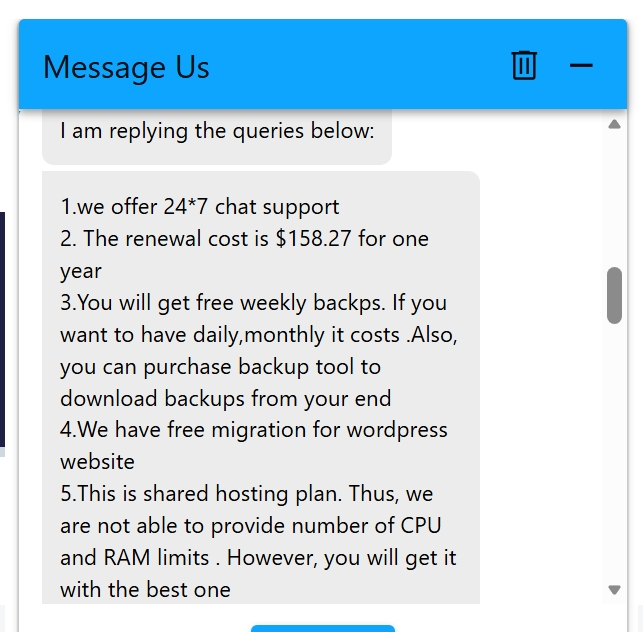
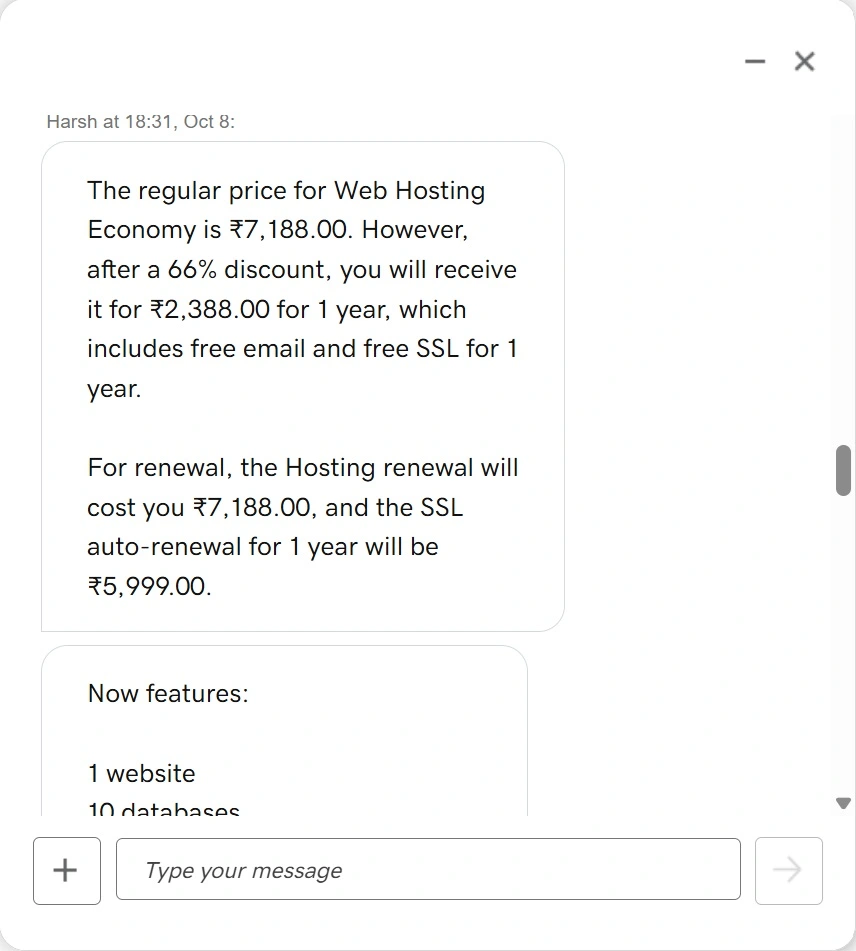
GoDaddy sales chat, 8 October 2026. HostGator sales chat on hostgator.com, 10 October 2026. GoDaddy details in my GoDaddy review.
Downtime is the biggest problem with any hosting, and it is the one thing no sales page talks about. Both companies have a public status page where they post outages, so I read both. Keep in mind that a status page only shows the bigger problems. If your site is down for a few minutes, or only one server has a problem, it usually doesn’t appear there.
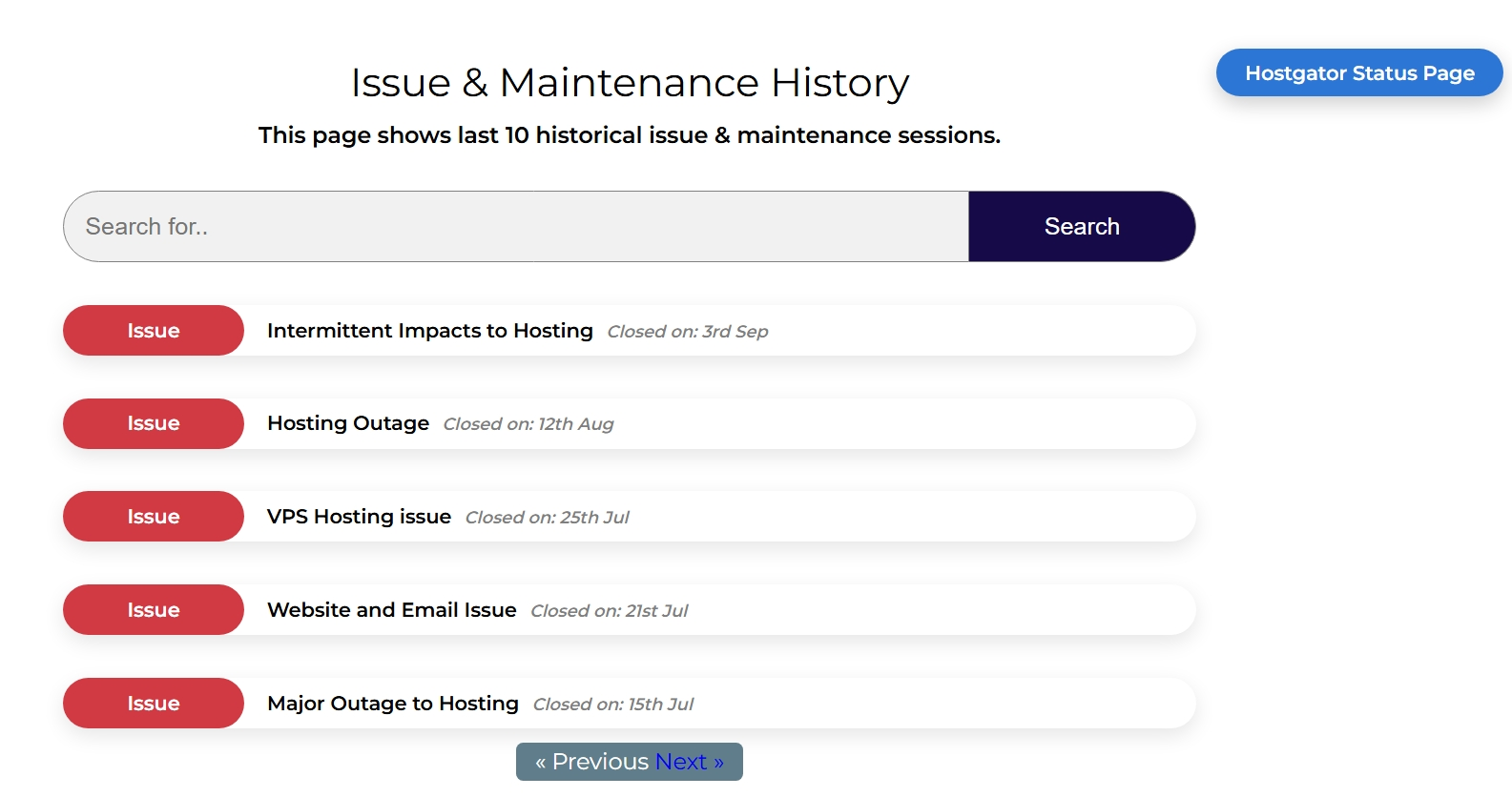
HostGator’s status page keeps a history you can scroll back through, with the start and end time of every incident. These are the hosting incidents from the last few months:
| Date | What HostGator reported | Services hit | How long |
|---|---|---|---|
| 2 Jul 2026 | Partial hosting outage | Hosting, email, DNS | 2 h 44 min |
| 8 Jul 2026 | Hosting working on and off | Hosting, email | 3 h 36 min |
| 15 Jul 2026Longest | Major outage, problem at a vendor facility | Hosting, email, account area | 8 h 27 min |
| 21 Jul 2026 | Some customers could not open websites and email | Hosting, email | 1 h 55 min |
| 11 Aug 2026 | Major outage | Hosting, email | 3 h 3 min |
| 3 Sep 2026 | Partial hosting outage | Hosting | 4 h 19 min |
From hostgator.com/status/history, checked 10 October 2026. Length is from the first to the last update of each incident. Shared hosting only, one VPS incident on 25 July is not included.
That is six hosting incidents between 2 July and 3 September 2026, adding up to about 24 hours. It does not mean every HostGator site was down for 24 hours. Most of them say “partial” or “some customers”, so they hit some servers, not all. The longest one, on 15 July, was a problem at one of their vendor’s facilities and took eight and a half hours to fix. After 3 September there was no hosting incident on the page up to 10 October, when I checked.
GoDaddy’s status page lists every product on its own line, from Web Hosting and Managed WordPress to DNS and Backups, which is useful when you want to know if something is down right now. But it shows only the last couple of weeks. On 10 October 2026 it listed two incidents: GoDaddy.com itself was slow for 29 minutes on 7 October, and the web hosting dashboard was slow for 27 minutes on 27 September. Neither of them took hosted websites down. GoDaddy also has an incident history page, but it loads by script and I couldn’t read older incidents from it.
So HostGator is clearly more open about its outages. But fewer outages on a status page is not the same as fewer outages, so I can’t say GoDaddy is more reliable, and I don’t give this round to either host.
| Uptime guarantee | HostGator | GoDaddy |
|---|---|---|
| Guarantee on shared hosting | 99% | 99.9% |
| Downtime allowed in a month | About 7 hours | About 44 minutes |
Both from their hosting pages, October 2026.
On paper GoDaddy promises more. But when a host breaks its uptime guarantee, you usually get some hosting credit, not money for the sales you lost, so I wouldn’t pick a host because of it.
Whichever host you pick, add your site to a free uptime monitor like UptimeRobot. It checks your site every few minutes and emails you when it goes down. After a month you will know your real uptime, which no status page can tell you.
This is the round most comparisons skip, and my speed test shows why it matters. HostGator says its servers are in Provo, Utah and Atlanta, Georgia, and all four HostGator sites I tested were on US servers. That is fine for visitors in North America and acceptable for Europe, but slow for Asia.
GoDaddy has data centers in North America, Europe and Asia. Three of the four GoDaddy sites I tested were on its Singapore server and answered in under 200 ms from Bangalore and Singapore. So GoDaddy gives you more choice of location. The catch is that you don’t always know which one you will get, so ask GoDaddy which data center your account will be on before you buy.
HostGator’s local websites in some countries were separate companies. The Indian one, for example, is now merging with BigRock and sends new customers there. If you want the HostGator plans and prices on this page, buy from hostgator.com.
Both hosts raise their price a lot after the first term. If that is your main worry, these two are worth comparing:
Where I moved my own site from GoDaddy. Lower price, and SSL, backups and CDN are included on the plan I use. It also has data centers in the US, Europe and Asia.
For cPanel with a low renewal price. It starts at $2.50 a month and renews at $8 (or $7 on their DirectAdmin plan), and InterServer says the price doesn’t go up after that.
For most buyers, yes. HostGator costs less for the first three years and at renewal, allows 10 sites on the cheapest plan, includes SSL and CDN every year, and was faster from the US and Europe in my test. GoDaddy is the better pick if your visitors are in Asia, because three of the four GoDaddy sites I tested were on a fast Singapore server.
HostGator. Hatchling is $3.75 a month for 36 months and renews at $10.99. GoDaddy Economy is $5.99 and renews at $11.99. Over six years that is about $531 on HostGator and $647 on GoDaddy, and GoDaddy Economy also charges for SSL from year two.
Partly. Their sales chat told me WordPress migration is free, and every plan has a free site migration tool. But their compare table says migration by their team is paid. So ask the price before you buy if you want them to move the site for you.
GoDaddy includes a daily backup you can restore from the previous day. HostGator gives weekly courtesy backups and says you are responsible for your own. Daily backups on HostGator cost extra. For a longer backup history on GoDaddy, its Website Backup add-on starts at $1.99 a month for one site and also includes uptime monitoring.
Nobody can say from the outside. HostGator’s status page listed six hosting incidents between July and early September 2026, about 24 hours in total, but most of them hit only some servers. GoDaddy’s status page shows only the last two weeks, so there is nothing fair to compare. The best way to know is a free uptime monitor on your own site.
Newfold Digital, the same company that owns Bluehost. Some of HostGator’s local country sites were separate companies, and the Indian one is now merging with BigRock.
Yes, 30 days on hosting. HostGator keeps $17.99 for the free domain if you cancel, and monthly plans are not refunded.